A survey by homelessness charity St Petrock’s has found that the number of women rough sleeping in Exeter has risen year-on-year.
In responses collected during the final week of September last year, it found that 22 women had slept rough, or in unsafe conditions, during the previous three months, an increase from seventeen in 2024.
It also found that seven survey participants had slept rough every night for the previous three months, an increase from one woman in 2024.
St Petrock’s published a report on its survey findings last week which concluded that women are “less likely to sleep in open public spaces due to fears around safety, harassment, and gender-based violence”.
It said that while some women, despite the risks, prefer to remain visible at night in public spaces such as Exeter High Street, many employ a variety of strategies and visit several different locations during the night in attempts to stay safe.
Seventeen of the women who took part in the 2025 survey reported having walked around all night.
The report also said that half of the women who took part in the survey had been in “some form of housing accommodation” immediately before sleeping rough, suggesting that “current housing services are not always effective in preventing women from becoming homeless”.
It said that there is just one female-only option for single applicants in the temporary accommodation provided by Exeter City Council, the rest of which is mixed-sex, while other housing providers only offer a handful of “low-support” female-only accommodation options.
Two-thirds of the women surveyed said that they needed “additional support or were not receiving the support they would like with housing”.
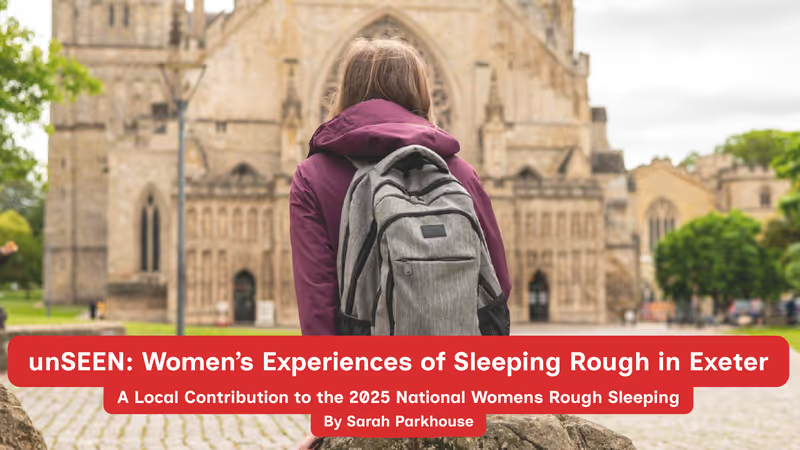 Unseen: Women’s Experiences of Sleeping Rough in Exeter report.
Sarah Parkhouse for St Petrock’s, June 2026.
St Petrock’s said that the survey findings demonstrate that the government’s official definition of rough sleeping – which only counts “people who are asleep, about to bed down, or bedded down in the open air” – does not “fully reflect women’s experiences of homelessness”.
The charity pointed out that a formal verification carried out during the survey week by an Exeter City Council-funded homeless outreach team – which is required to use the government definition – only counted seven women sleeping rough.
This is fewer than half the women identified as sleeping rough by the survey, which instead defines sleeping rough more broadly as “having nowhere to go at night” and includes women who might not be in this position every night and might not sleep outside when they are.
In addition, the survey recorded a total of 86 different rough sleeping locations, or situations, used by the women who responded – 58 of which are excluded by the government’s definition.
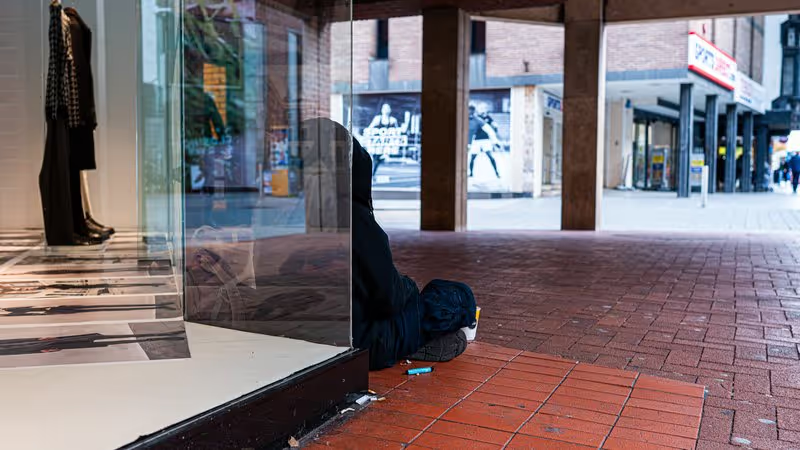 Rough sleeper in Exeter High Street. Photo: St Petrock’s.
The week-long women’s rough sleeping survey conducted by St Petrock’s last year followed a survey commissioned by Exeter City Council in 2024 which used the same methodology.
The women who took part were found through “outreach, when accessing services, within supported accommodation settings and through an established women’s group”.
St Petrock’s undertook the 2025 survey after the council said it lacked the resources to repeat the exercise.
It said it did so to gain a “clearer understanding of women’s experiences, circumstances, and support needs while sleeping rough” while also contributing to national data being collated by Solace Women’s Aid and the Single Homeless Project.
St Petrock’s director Peter Stephenson said: “When the city council decided it didn’t have the capacity to lead the women’s homelessness census last year, we did not hesitate to step in and make sure women’s voices were heard”.
 Rough sleeping spot near Fore Street, Exeter. Photo: St Petrock’s.
The publication of the St Petrock’s survey report last week follows the publication of the 2025 rough sleeping snapshot in February this year.
The annual snapshot, which was conducted overnight on 11-12 November 2025, recorded 51 people sleeping rough in Exeter – a five-fold increase on 2024.
The snapshot, which is intended to capture the number of rough sleepers on a “typical night”, is co-ordinated by Exeter City Council each year on behalf of the government. It uses the government definition of rough sleeping.
The huge increase in recorded rough sleepers in Exeter between 2024 and 2025 is partly the result of the council changing its approach after St Petrock’s said it “consistently underestimated” the true extent of Exeter’s rough sleeping.
The charity urged the council to stop employing a method which, among other limitations, excluded people who aren’t bedded down at the moment of observation, and instead to supplement a physical count with intelligence provided by partner agencies.
However, the change in methodology between the 2024 rough sleeping snapshot, using the council’s previous approach, and the 2025 snapshot, using the enhanced approach, does not itself account for the dramatic increase in recorded Exeter rough sleeping year-on-year.
St Petrock’s estimated that 24 people slept rough on the night of the 2024 count, suggesting that rough sleeping in Exeter has at least doubled since.
At the same time, national snapshot data shows that the rough sleeping rate in Exeter in 2025 was the fifth highest in England, lower only than the City of London, the London boroughs of Westminster and Camden, and Hastings.