Exeter City Council has been criticised for submitting a heritage statement which included apparently AI-generated text as part of an application to itself in its role as local planning authority.
The statement was submitted in support of an application to cover 37 of Exeter Corn Exchange’s upper storey windows in Market Street and Guinea Street with plywood hoardings covered in vinyl advertising graphics after the crumbling concrete window frames were found to pose a safety risk.
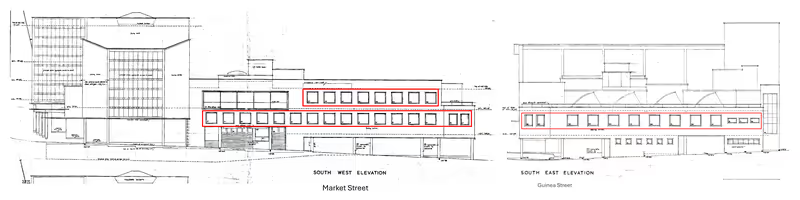 Exeter Corn Exchange elevations with replacement window hoardings. Source: Exeter City Council.
The heritage statement included two paragraphs of text which are actually from a 2013 newspaper article about Bourne Corn Exchange in Lincolnshire, 195 miles from Exeter, which is reproduced on the Bourne Corn Exchange website about page.
They mentioned Bourne Organ Club and a 1969 meeting of Bourne Urban District Council, which was abolished in April 1974.
The hallucination prompted Exeter Civic Society to comment, in its objection to the city council’s application, that the “heritage statement appears to have been written by AI and needs revision”.
The civic society added that it was “shocked and surprised” that the planning application was “signed off and submitted” by the city council, which it said needed to be “much more thorough”.
Exeter City Council subsequently uploaded a replacement heritage statement to its planning portal from which the Bourne Corn Exchange history had been removed, but apparently still got its dates mixed up.
It dated its replacement statement 5 May, the day before the civic society pointed out the rogue text, but didn’t actually produce the document until 11 May, six days later.
It then granted itself planning permission for the window-covering hoardings last week.