When Phil Bialyk was elected as Exeter City Council leader in May 2019, Labour held all but ten of the council’s 39 seats. It now holds eighteen after losing half those it was defending at this year’s local elections – along with its council majority.
Only four of the Labour councillors who elected Phil Bialyk to lead the council seven years ago were still present to witness him cling on as leader at its annual meeting this week, which he did without a vote being held.
As leader he is entitled to appoint the members of the council’s executive committee, also without a vote. But because it is Labour’s turn to hold the non-political position of Lord Mayor he only had sixteen councillors from which to choose.
As a result he has only been able to muster enough members to fill six executive seats in addition to his own, three short of the committee’s complement of ten, while also filling the seats allocated to the party on the council’s principal non-executive committees (on which neither executive members can sit nor the Lord Mayor vote).
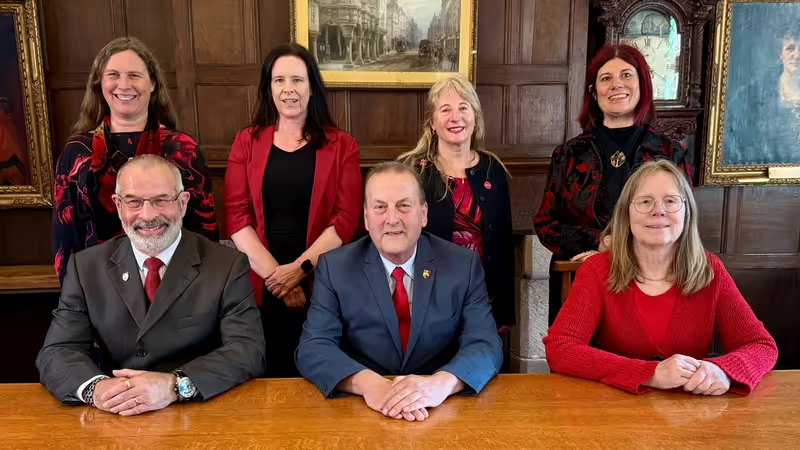 Exeter City Council executive committee, May 2026. Photo: Exeter City Council. From rear left: Liz Pole, Susannah Patrick, Yvonne Atkinson, Lucy Findlay, Duncan Wood, Phil Bialyk and Ruth Williams.
Under what was the “Exeter convention”, executive seats also used to be given to opposition leaders, enabling Exeter’s political parties to take important decisions affecting the city together.
But one of Phil Bialyk’s first acts after taking over as council leader in May 2019 was the initiation of a governance review which led, less than six months later, to the “deletion” of the convention. He commended the constitutional changes that resulted as “appropriate for an ambitious council looking to enhance the democratic process”.
Following this year’s elections, and despite calls from the Green Party – which gained three seats at Labour’s expense and won a much larger vote share – for a “co-operative council” to “put people before politics”, Phil Bialyk said he would carry on as a minority Labour leader on his own.
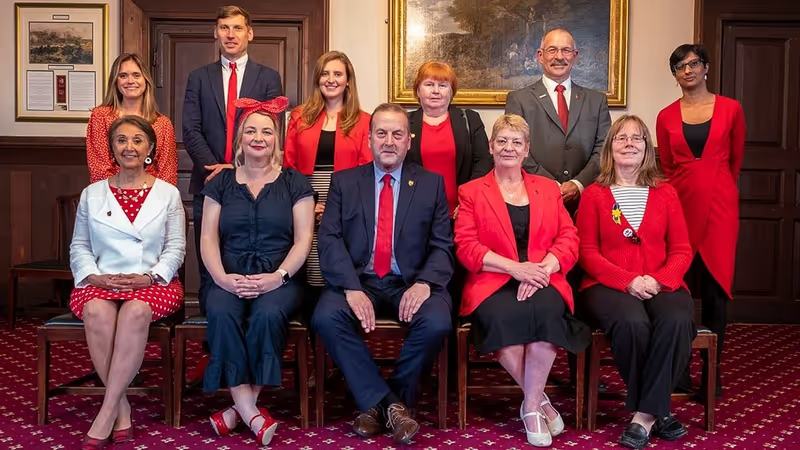 Exeter City Council executive committee and member champions, May 2022. Photo: Exeter City Council.
All but three subsequently quit, were deselected or lost their seats.
He hasn’t only been forced to cut his executive committee numbers. Several members have had to load up on their portfolio-holding responsibilities, and he has filled one seat with a complete novice, Lucy Findlay, less than a fortnight after she was elected.
He has also finally been forced to cede Labour occupation of both the council’s scrutiny committee chairs after persistently defying the widely-respected convention that opposition councillors should play these important local government check-and-balance roles.
He has not, however, given up control of scrutiny itself, having kept Labour councillor Matthew Williams in the chair of the council’s illicit Scrutiny Programme Board, which continues to decide what the council’s scrutiny committees can, and cannot, discuss.
Nor has he given up Labour possession of the council planning committee chair, from where Paul Knott has ensured party members follow the whip in approving a stream of co-living and student accommodation blocks over the past three years.
All 24 of the council’s “strategic appointments” to outside bodies have been taken by Labour councillors, too.
This means that executive member and now deputy leader Ruth Williams still sits on the boards of Exeter Canal & Quay Trust, Exe Estuary Management Partnership and South East Devon Habitat Regulations Executive Committee at the same time as remaining Exeter Harbour Board chair and an Exeter Port Authority duty holder – overseeing the council’s plans for Exe estuary maritime life.
It also means that Labour still holds all three councillor seats on the Exeter Community Safety Partnership board despite the party no longer representing any of the city centre wards where the partnership does most of its work.
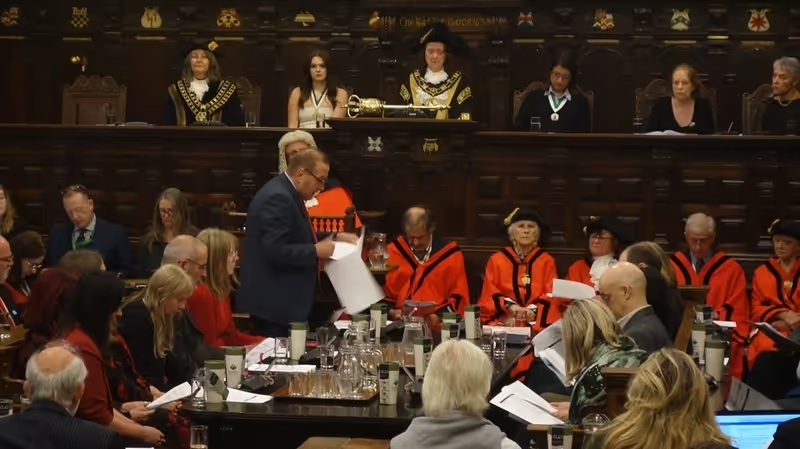 Phil Bialyk at Exeter City Council’s annual meeting on 20 May 2026
Leading the council may nevertheless prove more difficult for Phil Bialyk than he expects as the new political year gets under way.
It remains to be seen whether the council will continue to breach local government legislation – and circumvent the scrutiny checks and balances it provides – by making executive decisions at full council meetings, where the Labour majority previously ensured that its proposals were approved.
Holding only seventeen of 38 votes (assuming the Lord Mayor doesn’t abuse the council constitution’s impartiality clause) would leave him relying on opposition support, which may not be forthcoming, to get these through.
Were changes made so that the executive committee made more executive decisions instead, to enable such proposals to pass unimpeded in the absence of opposition committee votes, the council would not be able to prevent its decisions being delayed or disrupted by being called in for review.
Even though this would not ultimately stop them being forced through, doing so would risk strengthening opposition resolve to withhold votes on matters which must be decided by the full council – such as the budget and all other significant spending and policy decisions.
One way or another, then, Phil Bialyk will need the support of councillors from other parties to lead the council. Yet he has begun the year by insisting that Labour can go it alone.