Exeter’s electors go to the polls on Thursday 7 May to elect fourteen councillors to represent them on Exeter City Council, one in each of the city’s thirteen electoral wards and a second in a a by-election in Heavitree to fill a vacancy following a councillor resignation.
Each of the thirteen would normally serve four-year terms but are expected to hold office only until April 2028, when the city and county councils are to be dissolved and replaced with a new unitary authority covering a wider area as part of the government’s local government reorganisation plans.
The fourteenth would normally serve a one-year term but is expected to continue in post until the council is dissolved.
Reform UK, the Conservative Party, the Liberal Democrats, the Green Party and the Labour Party are each fielding candidates for all fourteen seats. In all but two of the city’s wards a five-way contest is taking place between these parties.
In Heavitree, where voters can cast two votes this year, two candidates are standing from each. There is also an Independent candidate standing in Heavitree and a Trade Unionist and Socialist Coalition candidate standing in Pennsylvania.
Only Exeter Green Party and Exeter Liberal Democrats have published profiles of each of their candidates on their websites. The Greens also published an Exeter manifesto last month, as did the Liberal Democrats. Exeter Labour published its manifesto late on Sunday night.
Neither Exeter Conservatives nor Reform UK Exeter has published a manifesto, although some Exeter Reform UK candidate leaflets can be found on a local branch Facebook page.
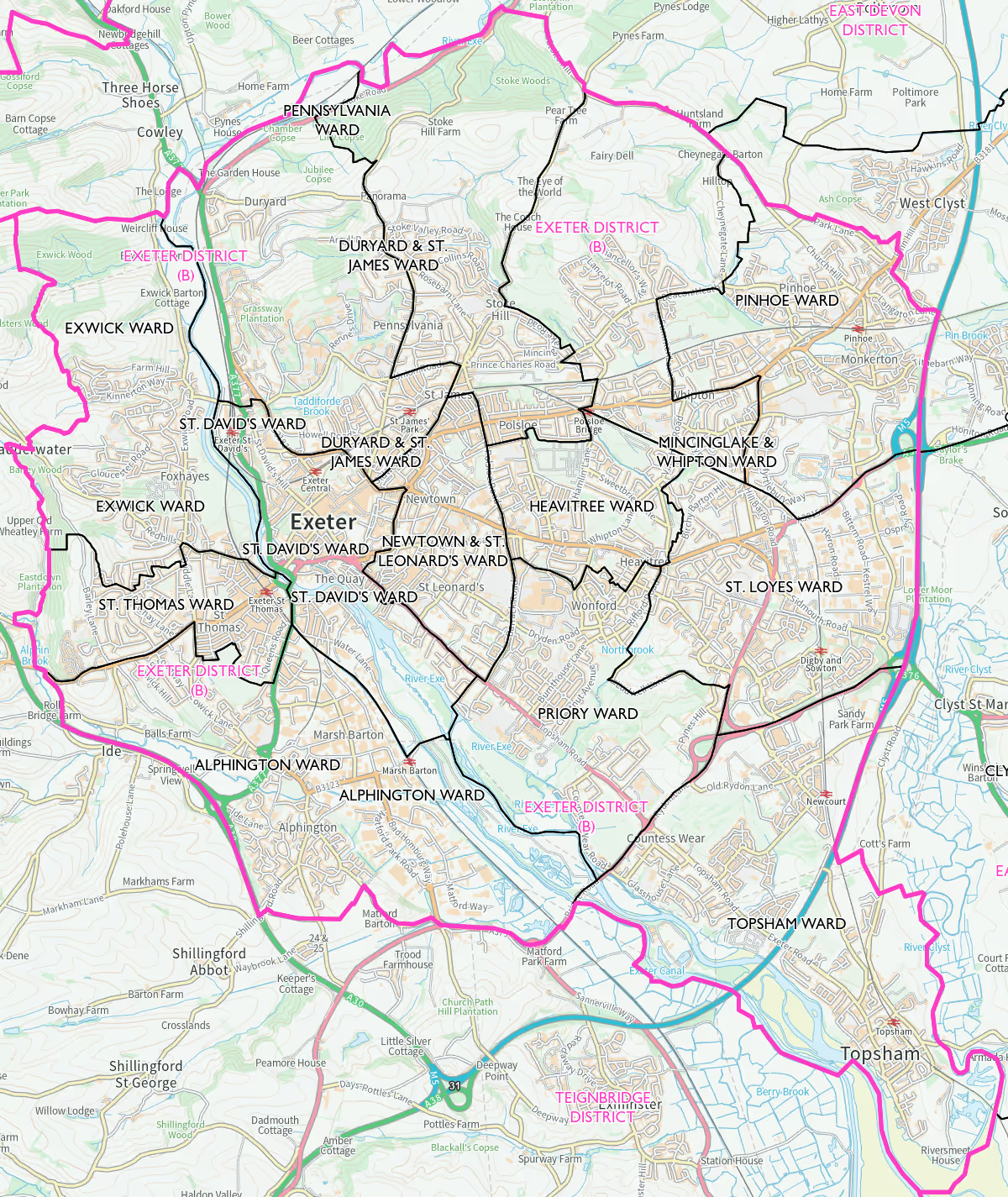 Exeter City Council electoral wards map. Contains Ordnance Survey and National Statistics data © Crown copyright and database right
There are 39 seats on Exeter City Council and just over 91,300 registered electors eligible to vote in this year’s elections. Each of thirteen wards of between 6,300 and 8,400 electors is represented by three councillors, each of whom normally serves a four-year term.
A third of the seats, one in each ward, is normally contested in each of three consecutive years, with county council elections held in the fourth year.
Exeter’s wards have been arranged this way since boundary changes prompted the exceptional election of the whole council at the same time in 2016, when 30 Labour councillors were elected.
The party had already then been in control of the council for four years. It has now been in this position for fourteen. The Electoral Reform Society says that councils which have been dominated by the same party for ten years or more suffer from “weak electoral accountability” which increases the likelihood of cronyism, corruption and spending decisions which offer poor value for public money.
Labour’s grip has slipped incrementally at Exeter City Council elections held since 2016. Two years ago, the last time all thirteen wards were contested, the Greens, the Liberal Democrats and the newly-formed Independent Group all took seats off the party.
It nevertheless still held 24 seats following the 2024 elections despite its support falling 6% across the city from the previous year, bucking the national trend in the run-up to the Labour general elections landslide two months later.
The council’s political composition then changed several times between May 2024 and May 2025. Alison Sheridan defected from the Conservatives to Reform UK in December 2024. She had previously stood for UKIP in Exeter six times between 2016 and 2019 then joined the Conservatives before eventually winning her seat in St Loye’s in 2023.
Zoë Hughes left Labour a few days later, eight months after being elected, to represent Pennsylvania as an Independent after health secretary Wes Streeting permanently banned puberty blockers for under-18s. Two city council by-elections were then held at the same time as last year’s Devon County Council elections following the resignations of Labour councillors Naima Allcock and Josh Ellis-Jones.
James Cookson held Topsham for Labour by just 28 votes and Tony Payne took Mincinglake & Whipton from Labour to become Exeter City Council’s first elected Reform UK councillor. Labour’s vote share in Mincinglake & Whipton fell to less than 28%, down from nearly 62% two years before. But that was before the council closed Northbrook pool.
Labour’s losses at the May 2025 county council elections were more dramatic: it was wiped out in Exeter to leave it without any representation at County Hall. At the same time the Conservatives lost 33 of the 40 seats they had previously held.
Both Labour and Conservative vote share fell in all nine Exeter county council electoral divisions. In the seven seats Labour won in 2021 its vote share fell significantly while the Conservatives also lost significant shares of the vote in seven of nine Exeter divisions. At the same time, the Liberal Democrats and Greens increased their vote shares in all divisions except one each.
In most Exeter divisions Labour and Conservative vote losses went mostly to Reform UK, which won vote shares ranging from 14% to 34%, except in Duryard & Pennsylvania, where the swing in favour of the Liberal Democrats and Greens combined was slightly greater than the vote share received by Reform UK.
The breakdown of the Labour/Conservative duopoly had already been widely predicted in national polling following Reform UK’s rise. Labour’s popularity had fallen from a high of about 52%, which it reached in October 2022 when Liz Truss was Prime Minister, to around 44% by the May 2024 local elections.
It then fell much further as Keir Starmer led the party to its July 2024 general election victory – it won 411 seats and a 174-seat majority on a vote share of just 33.7%, the lowest of any governing party on record making it the least proportional general election in British history.
Support for Labour is now languishing around 18% in most national poll aggregators, often behind the Conservatives and only just ahead of the Greens, and academics and pollsters have lined up to predict calamitous outcomes for Labour in this year’s elections.
The party is variously expected to lose between 1,500 and 2,000 of the 2,500 seats it is defending on Thursday in what would be its worst-ever local elections performance, alongside yet more Conservative losses. Reform UK could gain more than 2,000 councillors, the Greens 450 and the Liberal Democrats 200.
It should have come as no surprise, then, that Exeter City Council leader Phil Bialyk seized the opportunity to cancel this week’s elections when the government provided it in January, or that Labour began rolling out pork barrels for the city soon after the government was forced to reverse their cancellation in the face of a High Court challenge brought by Reform UK.
Labour enters tomorrow’s ballot holding 22 seats and defending eight of them. It has to win six or more of the fourteen seats which are up for election to stay in control of the council, but will remain the largest party no matter how badly it fares.
The Greens are now the largest opposition party with six seats, although they are effectively defending three of seven seats following the vacancy created in Heavitree by the recent resignation of Carol Bennett.
If they hold all their seats and get the results they hope for elsewhere in the city their tally could increase to as many as twelve seats – still eight short of a majority and with fewer seats than Labour no matter what.
Reform UK, which is defending one of its two existing seats, could end the night with as many as eleven if it makes gains across the city at the expense of all of Labour, the Greens and the Conservatives.
The Liberal Democrats are defending just one of the four seats they hold, and may well end the night where they started. The Conservatives are also defending one of two seats. Neither of the council’s two Independents are up for election this year.
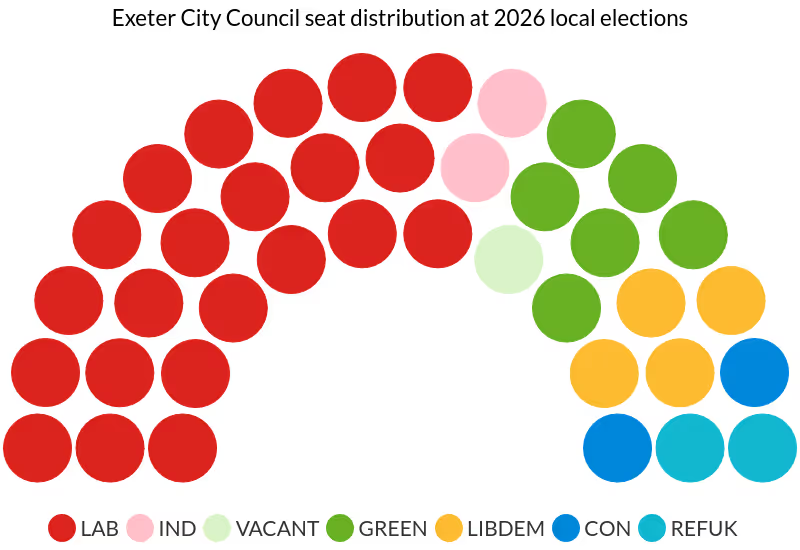
Reform UK’s potential to turn Exeter electoral politics on their head this year cannot be underestimated, and Tony Payne looks likely to hold Mincinglake & Whipton for the party after winning its first city council seat last year.
It would nevertheless be a surprise to see the Greens lose in St David’s, where opposition leader Diana Moore was first elected for the party in 2019 and it has won every election since. Criminology professor and trade unionist Brian Rappert hopes to take over from Tess Read, who is standing down at the end of her term.
Liberal Democrat Kevin Mitchell also looks secure in his Duryard & St James seat after 22 years as a city councillor, notwithstanding the challenge being mounted by Sidwell Street business owner Mithat Ishakoglu for the Greens.
Council executive member Matt Vizard, who works for Exeter MP Steve Race, is defending Newtown & St Leonard’s for Labour. Green candidate Bernadette Chelvanayagam, who works for a local voluntary and community sector organisation which supports households in fuel poverty, hopes to win there for the party for the fourth year running.
Gill Baker, who works at the Royal Devon & Exeter Hospital, also hopes to take a seat from Labour for the Greens by winning in Pennsylvania, where erstwhile Labour executive member Josie Parkhouse is standing down.
Paula Black, who has been using aliases “Paula Noire” and “Paula Woke-Noire” to anonymously attack critics of Exeter Labour on social media, Liberal Democrat candidate Will Aczel and veteran Rob Hannaford, who is standing for the Conservatives but has previously been a Liberal Democrat, Labour and Independent councillor in Exeter, all also hope to win the seat.
Every vote will count here as the bulk of the vote share is likely to be split several ways. However if national voting intentions are reflected locally, both Labour and the Conservatives will lose ground to Reform UK, leaving the Greens and Liberal Democrats competing for first place.
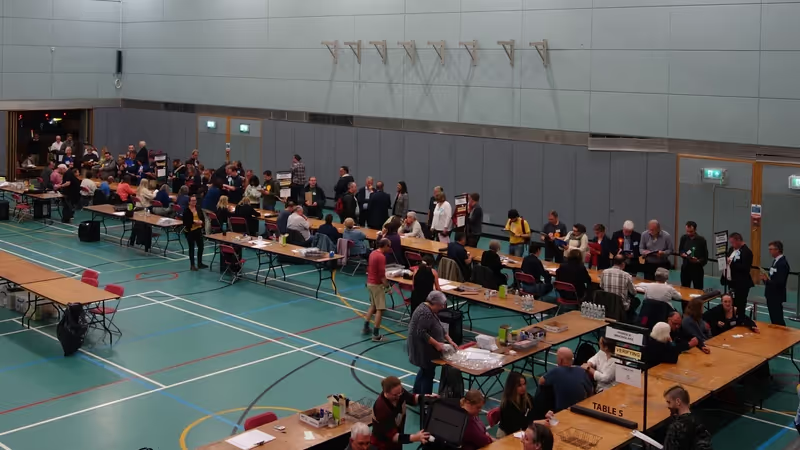 Riverside Leisure Centre 2025 Exeter local elections count
Heavitree is also tricky to call, not only because the electorate can vote for two candidates and thereby two different parties. Archaeologist and heritage consultant Stella Smith and project manager Helen Terry hope to retain both seats for the Greens while NHS worker Tina Beer and ex-civil servant Lisa Norris aim to win them both for Reform UK.
The vote share is likely be split several ways in St Thomas too, where deputy council leader and executive member Laura Wright is hoping to hold the seat for Labour. The Greens’ Jack Reed, Liberal Democrat Vanessa Newcombe and Reform UK’s Robert-James Cockburn are all also contenders.
Three more seats held by Labour executive members are hanging in the balance. Bob Foale is standing down in Alphington where Lucy Findlay hopes to replace him while Duncan Wood and Marina Asvachin are both seeking re-election, in Pinhoe and Priory. Labour council planning committee chair Paul Knott is also hoping to hold on to his seat in Exwick.
Reform UK candidates won in all three of the divisions which largely overlap these wards at last year’s Devon County Council elections, in each by small margins on large swings. Its candidates in each ward are Jayden Palmer, Ashton Messer, Nick Williams and Lee Gillett.
Reform UK candidate Chris Owen is also expected to do well in St Loye’s, where Conservative group leader Peter Holland is standing down after twelve years on the council and Joan Collacott hopes to replace him.
At the same time Cynthia Thompson is hoping to reclaim Topsham for the Conservatives after Andrew Leadbetter held Wearside & Topsham decisively for the party in last May’s county council elections and Labour only narrowly won the city council by-election held at the same time with the Conservatives in second place.
Reform UK’s candidate here, Sue Davies, already represents the sprawling Devon County Council Hatherleigh & Chagford division wrapped round Okehampton 25 miles to the west.
Subscribe to The Exeter Digest, our free email newsletter, for more local election coverage including full election results from the count early on Friday morning and our snap analysis of their significance.
As last year, we will run a rolling results service complete with graphical analysis of vote shares and swings as the winners and losers are announced on the night.
Our 2026 elections briefing covers when, where and how to vote as well as voting by proxy, voter ID requirements and revised regulations that apply to postal votes.