Independent think-tank Centre for Cities has found that Exeter’s economic growth and living standards performance is among the worst in the country’s 63 largest cities and towns.
Its 2026 outlook report focussed on the relationship between economic performance and living standards in the primary built-up areas which it assesses in its annual comparison studies. It also considered data on housing, skills, employment, innovation and productivity in each area.
It found that Exeter saw declining living standards alongside below-average economic growth in the ten years to 2023, placing it among the worst performers in the country alongside Aberdeen, Birkenhead, Burnley, Dundee, Ipswich, Middlesbrough, Sunderland and Wigan.
Disposable income per resident fell in all nine areas. Centre for Cities said that had these places improved living standards on a par with the best-performing areas, their residents “would have had an extra £9,400 in their pockets over that decade”.
 Best and worst performers on economic growth and living standards since 2013. Source: Centre for Cities.
Its 2026 report also placed Exeter fourth from bottom on the city’s ratio of private to public sector jobs, one place above Cambridge, and fifth from bottom for average weekly workplace earnings at £628.10.
Earnings in Cambridge, however, were second only to London, and nearly 150% higher than Exeter at an average of £924.50 per week.
As a result, Exeter has the seventh most unaffordable housing in the country even though average house prices here are the lowest among the top ten least affordable cities.
The report also found that Exeter had the highest population growth rate among the 63 places in the study – 15.5% – as the number of people living here increased from just under 120,000 in 2014 to more than 138,000 in 2024 – a rise of 18,610.
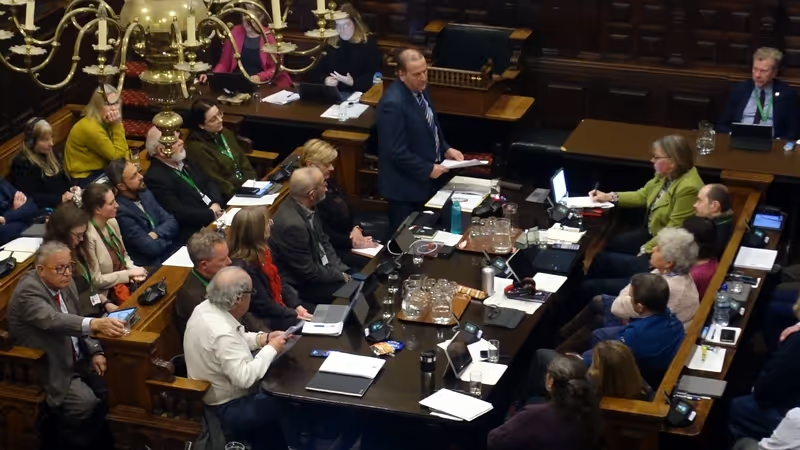
Exeter City Council leader Phil Bialyk seized on this finding to lead his budget speech at the council’s meeting a fortnight ago, but failed to mention any of the report’s other insights into the city’s misfortunes.
He also ignored the impact of student numbers on Exeter’s population. During the 2013-14 academic year there were just over 26,500 students registered at the Streatham and St Luke’s campuses, rising to just under 32,500 by 2023-24 – an increase amounting to one third of the whole city rise.
Newtown & St Leonard’s councillor Matt Vizard followed Phil Bialyk at the meeting. He said: “Isn’t it great that Exeter is the fastest growing city in UK? Reflect on that for a moment. That’s incredible, that’s not by accident”.
He added, referring to the last fourteen years during which Labour has been in control of the council: “I think the leadership of the council here over the past decade and more has been absolutely critical to that, as has the work of our previous MP and our current MP for the city.”