Exeter’s local elections are to go ahead as originally planned on Thursday 7 May after the government reversed their cancellation in the face of a High Court challenge brought by Reform UK.
Secretary of State Steve Reed has written to the leaders of the 30 affected councils – which were told their May elections would be cancelled three weeks ago – to tell them that he has instead “decided to withdraw his decision” following “recent legal advice”.
A High Court hearing had been due to take place on Thursday in response to a judicial review claim brought by Reform UK against Steve Reed’s decision. The government has now said it will pay Reform UK’s costs in bringing the claim.
Two-thirds of the affected local authorities – which Steve Reed had labelled “zombie councils” in an opinion piece for The Times just before cancelling their elections – are Labour-led.
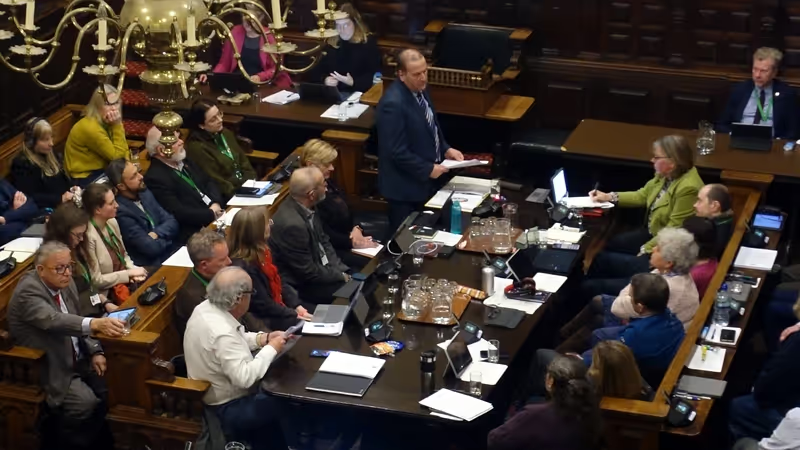
 Exeter City Council leader Phil Bialyk and deputy Laura Wright at the Palace of Westminster.
Photo: Exeter City Council.
Exeter City Council leader Phil Bialyk, who told last July’s city council meeting that he had no intention of asking to postpone democracy this year, then told January’s meeting that he would do so after all.
He subsequently sought to insist that the council would not be “suspending democracy” before green-lighting the elections cancellation the following day. He now claims that he welcomes the news the elections will go ahead.
The cancellation would have meant Labour retaining power in Exeter for two more years until the city council is dissolved in April 2028.
Eight Labour councillors, among them deputy leader Laura Wright, would have kept their seats in May instead of standing for re-election – and been paid £145,924 in allowances they would otherwise not have received had they lost their seats.
Phil Bialyk would also have carried on as council leader – a role in which he received more than £32,000 in allowances and expenses during 2024-25 – with the support of his local party.
Instead, now that the city council elections will take place as planned, Labour will have to defend these eight seats in May. As it currently holds 22 seats, it has to win six or more of the thirteen seats which are up for election to stay in control of the council.
It looked very vulnerable in most of these seats before the elections were cancelled, after losing more than half of its support across Devon in the May 2025 county council elections and all the county hall seats it previously held in Exeter.
Its popularity had subsequently fallen further before it showed Exeter’s electors that it could not be trusted with democracy. Now it has to convince them that it can be trusted with their votes.