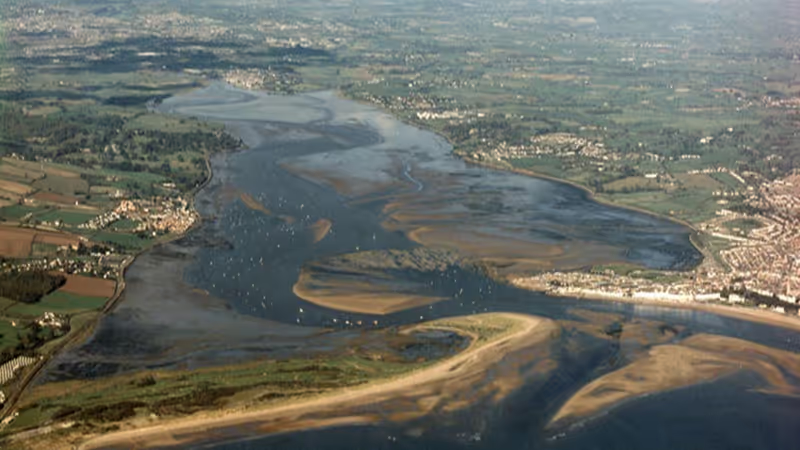
Exeter City Council, in its roles as port and harbour authority, is responsible for eleven miles of waterways, including the historic Exeter Ship Canal, from Blackaller Weir to a mile out to sea, as well as numerous buildings and miles of estuary land.
It must navigate relationships with a wide range of stakeholders including smaller harbours and quays, mooring associations, marine businesses, pubs, port premises tenants, fisheries, clubs and multifarious communities along the estuary’s length.
Waterways user groups, advocacy organisations and multi-stakeholder management bodies tasked with protecting the estuary, which is an internationally-important wildlife and habitats site, all also have a say.
In this special report we look at the council’s decision to pursue Port Marine Safety Code compliance following the failure of its attempt to pass on its responsibilities as harbour authority after negotiations with river users broke down over the imposition of licensing fees.
We revisit its appointment of a harbour master and marine staff to work towards code compliance, its creation of a harbour board to oversee operations and its decision to seek a Harbour Revision Order to consolidate and extend its powers to make and enforce waterways rules and levy harbour dues.
We consider the council’s attempts to divert attention away from the prospective imposition of new fees and charges on river and canal users, as well as tensions between their needs and its hopes that land essential to canal operations is redeveloped for flats.
We trace repeated attempts by harbour board members to raise widely-held concerns about the potential impact of new harbour dues, which waterways users say will put the viability of the estuary in jeopardy, and the council’s failure to address these concerns when it held an informal consultation on the draft order.
We look at the significant increase in harbour operations costs which followed its decision to pursue Port Marine Safety Code compliance, and how they and canal operations costs together came to close to £1 million in 2022-23, requiring a council waterways subsidy in excess of £750,000.
We also look at the capital costs the council has to bear along the length of the estuary, dramatically increasing its financial liabilities as port and harbour authority, and its quiet adoption of a new policy last year that waterways operations should be entirely subsidy-free.
We outline wider concerns around the weather’s impact on the estuary and the danger of waterways income falling just as expenditure rises still higher, and we review the recent statutory consultation on the council’s Harbour Revision Order proposals which has brought matters to a head.
We then consider the practical challenges of imposing new charges and the reasons why estuary boat owners, in particular, are concerned about the council demanding they pay excessive dues. We also survey the views of a wide range of waterways stakeholders on the council’s approach.
We ask why the council has not produced a business plan which assesses the feasibility of imposing new charges and the operational and capital spending needed to bring the services and facilities it offers up to scratch in the six years since it decided to pursue Port Marine Safety Code compliance.
We also outline the basis of an equitable solution to the problems the council has created, involving Exeter Canal & Quay Trust and a maritime revival strategy built on local volunteer efforts which lays out the quay and canal basin’s potential to become a leading inland heritage port at the head of an estuary that is otherwise at risk of significant decline.
Exeter quay and canal basin drone footage. Source: Mat Perry photography.
Exeter City Council is both port authority and statutory harbour authority for the Exe estuary and Exeter Ship Canal, one of the oldest artificial waterways in the UK, which runs for more than five miles from the city’s historic quay and canal basin to reach the river at Turf Lock.
In these roles it is responsible for eleven miles of water from Blackaller Weir beside Mill on the Exe to a mile out to sea, past Exmouth to Straight Point in the east and Dawlish Warren to Langston Rock in the west.
It also owns, and is responsible for, numerous buildings and miles of estuary land, including most of the quay and canal basin, all the land adjoining the canal, Double Locks public house, The Turf hotel, Topsham Lock Cottage, Topsham Ferry and Topsham Quay.
It provides in-water boat storage at Turf Boat Haven and in-water and on-land storage at the canal head. It also provides canal convoy and craning to enable canal head boatyard access, visitor canal berths and river moorings and other marine services as well as fishing on both waterways.
Exmouth Dock Company is a separate statutory harbour authority for Exmouth Dock, which now operates as a marina, but the statutory limits of both harbour authorities currently overlap.
 Exeter Port Limits Plan. Source: Marine Management Organisation.
Large commercial vessels stopped using Exeter as a port in the 1970s. But thousands of people – residents and visitors – now make use of the canal and river estuary for a wide range of waterborne activities from kayaking to kite-surfing, paddle-boarding to power-boating, rowing to sailing.
Moorings are provided by associations including LEMA, which operates on behalf of East Devon District Council, and Topsham Moorings, which took over from Topsham Mooring Owners Association in March. Cockwood Boat Club & Harbour Commissioners and Lympstone Fishery & Harbour Association both manage private harbours accessible only to those living nearby.
These associations lease estuary fundus from The Crown Estate then license boat owners to lay buoys in turn. The Earl of Devon, unusually, following a 150-year dispute with the Crown, controls an area of the fundus between Starcross and Turf Lock where moorings are also provided.
Starcross Yacht Club, Starcross Fishing & Cruising Club and Topsham Sailing Club are all nearby.
A wide range of commercial activities including farming and fishing also go on in and around the estuary – Molluscan shellfish farming is a significant local enterprise – and there are two boatyards at Topsham, Retreat and W. Trout & Son, as well as M. S. Marine Services at Exmouth.
Exe Watersports Association houses canoe, rowing, dragon boat and sub-aqua clubs opposite Haven Banks Outdoor Education Centre at Exeter quay and canal basin. Numerous other businesses trade nearby including AS Watersports and Saddles and Paddles as well as cafes, restaurants and bars. The situation is similar at the Exmouth end of the estuary.
Moorings on the River Exe. Source: Exe Estuary Management Partnership.
Exeter City Council, as port authority and harbour authority, not only has to navigate relationships with all these estuary stakeholders, it also has to navigate three waterways user groups. One represents Exmouth water users, another river and canal users and a third Exeter port users. Friends of Exeter Ship Canal also plays an advocacy role.
Then there’s Exe Estuary Management Partnership, which brings together representatives of a long list of local authorities, government agencies, conservation groups, commercial and recreational interests to ensure sustainable use and stewardship of the estuary, which is an internationally-important site for wildlife and habitats.
It includes two sites of special scientific interest, a Ramsar site, and a wild bird conservation special protection area. During winter tens of thousands of birds depend on it to rest and feed on long migratory journeys from places as far away as Siberia.
South East Devon Habitat Regulations Partnership also oversees and seeks to protect the estuary, as well as nearby East Devon Pebblebed Heaths, with a particular focus on Dawlish Warren, a 500-acre sand dune spit on the western side of the estuary mouth which is one of several estuary nature conservation sites.
Dawlish Warren is home to thousands of species but is being rapidly eroded in changing weather conditions. It sits alongside dozens of other shifting sand banks which make the estuary’s shallow tidal waters much more difficult to navigate than deep water harbours at Dartmouth, Salcombe, Plymouth and elsewhere in Devon.
 Exe Estuary management roles overview, 2018. Source: Exe Estuary Management Partnership.
Twenty years ago Exeter City Council sought to pass on its responsibilities – and liabilities – as harbour authority to a proposed new trust port organisation to be called the Exe Estuary Navigation Authority, based on terms agreed with the then-Exe Estuary Users Association.
In 2006 it submitted a draft Harbour Revision Order – a statutory instrument used either to amend or introduce new legislation under the Harbours Act 1964 – to the Department for Transport for approval, but the agreement between the council and the river users broke down because the council sought to impose higher licensing fees on boat owners than they were willing to accept.
The council later explained this by saying that “initial strong support for the HRO amongst stakeholders began to waiver with concerns over the financial viability of a trust port” after “suggestions that income projections, based on both the number and length of vessels mooring within the port, were too ambitious”.
It also separately admitted that the Department for Transport had rejected its application because it “would not achieve the statutory objects for which Harbour Revision Orders may lawfully be made”. It decided, instead, to review its options for the “future management of the estuary, quay, basin and canal in consultation with users of the Port of Exeter area”.
Then, in 2018, the Department for Transport issued new governance guidance for statutory harbour authorities. This said that the government had a “strong expectation” that all harbour authorities would comply with the Port Marine Safety Code, a national standard for port safety introduced in 2000 following the 1996 Sea Empress disaster and updated every few years since.
Compliance with the code (recently renamed the Ports & Marine Facilities Safety Code) is not mandatory as the code is not statutory, and much of it is aimed at safety in large commercial ports. However it refers to legal duties which are required of all harbour authorities, so not adhering to its provisions may indicate a breach of those duties and could lead to liability or prosecution.
The Department for Transport describes the code as providing a “measure by which organisations can be accountable for discharging their statutory duties to run harbours safely and effectively”.
 Ports & Marine Facilities Safety Code (recently renamed). Source: Department for Transport.
In response, Exeter City Council decided to appoint a dedicated harbour master and team of two marine staff to work towards code compliance alongside its existing canal management team. It followed up, two years later, by creating a harbour board to oversee and direct “all aspects of the harbour operation”, in particular marine safety, as part of the governance framework it said would be necessary to successfully obtain Port Marine Safety Code compliance.
It also tasked the new board with ensuring that the council, in its role as harbour authority, adopted “appropriate powers for the effective enforcement of [its] regulations, and for the setting of dues at a level which adequately funds the discharge of all [its] duties”.
Despite the council monitoring officer’s warning that doing so would be “expensive and time consuming and may result in a public inquiry”, the harbour board was also instructed to “investigate the potential for applying for a Harbour Revision Order” to give the council new waterways powers.
The new harbour board met for the first time in September 2021, following the recruitment of six independent persons to sit alongside its six councillor members.
It soon became clear that the council wanted the powers which a new Harbour Revision Order would confer to enable it to levy harbour dues on all the Exe estuary’s waterways users, regardless of the size of their craft, as much as it wanted them to enable Port Marine Safety Code compliance.
At the board’s June 2022 meeting a council officer said: “A successful application for a Harbour Revision Order would help to ensure the safe running of the port, having sufficient powers to be able to levy harbour dues on vessels and carry out appropriate enforcement on the river and canal.”
 Exe Estuary Management Partnership area boundary.
Contains OS data © Crown copyright and database right 2006.
Source: Exe Estuary Management Partnership.
In December 2022 the council committed itself to pursuing the new Harbour Revision Order.
Mincinglake & Whipton councillor Ruth Williams, who by then had taken over as harbour board chair, told the meeting that she had “started to meet informally with water sports associations and other relevant organisations with an interest in the Harbour Revision Order to discuss its implications, including issues around charging”.
The council approved a £150,000 budget to cover the cost of the Harbour Revision Order application and any public inquiry that might follow – twice the £75,000 the harbour board had been told it would cost a few months earlier.
The executive committee report on which its decision was based said a key reason for pursuing the new powers was “to generate income streams through harbour dues” to “partially offset the revenue costs of running a harbour team and maintaining navigation”.
It explained that the council did not already possess the port management powers employed by other statutory harbour authorities because of a “historical anomaly resulting from the council not incorporating the Harbours, Docks and Piers Act in 1847” – which enables the creation of port police officers as special constables.
The report also optimistically said that the council’s second Harbour Revision Order application would be “far less contentious” than the first, “largely delivering what the users of the harbour want to see”. It added that it was “essential that all opportunities for additional income are explored”.
An accompanying options appraisal confirmed that a key reason for not simply revising existing harbour bye-laws was that the council would be “unable to collect harbour dues from water users” without which it would have to “continue to cover all cost of running the waterways team”.
A key reason for not simply continuing as things were would be that the council would be “unable to collect dues so there would be no possible income stream”.
It also said that “the introduction of harbour dues” could cover the Harbour Revision Order cost of up to £150,000 “in a relatively short period of time” because the outcome would enable the council to levy dues in “both river and canal”.
Two days after the council took the decision to pursue a new Harbour Revision Order two members of Ashfords’ specialist Harbour Revision Orders team attended a harbour board meeting to lay out the process of getting the new legislation approved.
 Exeter Port Authority port passage plan. © Crown copyright and database right.
Source: Exeter City Council.
Waterways stakeholders had already begun raising concerns about the potential impact of imposing new fees and charges on river and canal users before the council had even announced its intention to consult them informally on the new Harbour Revision Order.
It didn’t help that the council buried its head in the sand. It began by omitting to mention the new charging powers the order would confer when it did announce the informal consultation, in May 2023.
It then published a short Q&A two months later entitled “Your questions answered over plans for a Harbour Revision Order in Exeter”, but this skirted round the issue of harbour dues and was subsequently deleted from the council website.
Meanwhile tensions between the needs of waterways users and the council’s hopes that hundreds of flats would be built in tall blocks immediately alongside the canal were surfacing, exacerbated by apparent overlaps between land identified as part of the Water Lane redevelopment site and land identified as part of the port in plans being drawn up for the Harbour Revision Order application.
Gabriel’s Wharf, the only canal bankside land from which it is possible to crane very heavy boats in or out of the water, looked to be at particular risk. It was rendered in developer’s drawings as “Water Square” – a stepped, sunken seating area in front of pavement cafes without a boat in sight.
 Gabriel’s Wharf replaced by Water Square in developer’s drawing. Source: Nash Partnership.
New fees and charges came up repeatedly in harbour board meetings despite Ruth Williams’ attempts to stop board members discussing them.
At the same time a port business plan, which was intended to address staff shortages that were preventing “much of the urgent and necessary works needed to keep the infrastructure going” and set “a more realistic budget”, was apparently prepared but never published.
In July 2023 Exeter Port Users Group said a quarter of the estuary’s moorings remained vacant following the pandemic and that its members were concerned about the lack of information about the new harbour dues that the council was expected to impose and the extent to which they might further harm the estuary’s prospects.
Board member Anthony Garratt said he had been contacted by Exeter Sea Scouts who were worried that the charges would be so high that they would have to shut up shop. He added that the harbour board ought to be considering what the charges would be for, what estuary users would need and want and how much the estuary would cost to run, then work out the new dues from there.
Board member Owen Michaelson said that the council’s silence on the subject had been deafening. He added that a wall of objections was likely if it didn’t get ahead of the issue and asked why draft charges could not be published, or at least the direction of travel set out.
Harbour master Grahame Forshaw said that the port would always require a subsidy from the council, and that there was no way it could be financially self-sustaining. Ruth Williams simply said that the council had communicated through its usual channels and that to think that the Harbour Revision Order was about charges was missing the point.
 Exeter Ship Canal moorings near Turf Lock. Photo: Friends of Exeter Ship Canal.
At the board’s September 2023 meeting Exeter Port Users Group again raised its concerns that nothing had been said publicly about the level of new fees and charges despite the council having submitted its Harbour Revision Order application a few days earlier.
It said many river users had been discussing the council’s plans for future waterways management, and whether they would be economically viable with the estuary’s very limited commercial revenue potential and the high cost of canal upkeep.
It also expressed concern about the council’s housing development plans in and around the port, which it said could restrict waterways access and lead to the loss of essential facilities including hard standing, craning and space for waterways businesses.
Board members Owen Michaelson and Anthony Garratt again tried to encourage the council to take a more proactive approach to communications with the aim of reaching as many people with a stake in the estuary as possible.
St David’s councillor and board member Tess Read asked when the board would discuss harbour dues, but Ruth Williams said it was not up to the harbour board to come with ideas around charging waterways users – although the board’s terms of reference actually say that it is.
The same concerns were still swirling when the board met in December 2023 – the lack of information about the Harbour Revision Order, the strength of feeling among waterways users about the imposition of harbour dues, the prospective impact of high-rise canalside housing development and the need to protect Gabriel’s Wharf.
None had been resolved by the time the informal consultation on the draft order began in February last year.
 Topsham Lock cottage. Photo: Friends of Exeter Ship Canal.
When the council launched the informal consultation it didn’t mention charges, and implied that only “port stakeholders” – rather than anyone concerned about the new powers – should respond.
An FAQ that has since been deleted from the council website managed to answer the question “How will ship, passenger and goods dues be set?” without mentioning that, as everybody involved knew, the introduction of new harbour dues under the new powers was inevitable.
Instead, the FAQ said: “The amount of any ship, passenger and goods dues which might be set is a separate topic – this does not relate to the HRO because the HRO does not set the level of them.”
The statement submitted in support of the draft Harbour Revision Order application to the Marine Management Organisation (which had taken over responsibility for making such orders from the Department for Transport in 2010) was much more revealing.
It offered justifications for the inclusion of each of the order’s articles in turn, ten of which directly address charging powers.
Article 10 provides powers to “demand, take and recover reasonable charges in respect of all vessels”, expressly including “a variety of other floating platforms etc. so that no dispute will arise as to whether such structures fall within the definition of vessel contained within the order”.
The justification for this provision was that “it is important to the port’s future viability that all users of the port contribute to the cost of the management and maintenance of the port.”
The justification for Article 14, which provides powers to seize vessels in lieu of guarantees against the payment of prospective charges, or refuse them entry to the harbour in the first place, was that “it is essential for the economic management of the port to be able to secure the reasonable charges due to the council by virtue its charging powers”.
Other articles would confer powers to prevent vessels landing, prevent them from leaving and to recover unpaid charges through the courts.
 Britannia under sail, now berthed in Exeter canal basin. Photo: Britannia Sailing Trust.
When the harbour board met in March last year, just as the informal consultation was coming to an end, Ruth Williams said that the council had now demonstrated that it was seriously committed to stakeholder engagement.
Exeter Port Users Group said that, while the three consultation drop-in sessions that had taken place had been “useful for most attendees”, many of those present had been “less satisfied, having thought that there would be some sort of presentation and a public question-and-answer session”.
It also said: “Many users, despite reassurance from various quarters, still see the HRO as a vehicle for increasing charges and imposing control where previously none was needed.”
Adding that this was unfortunate because many parts of the proposed legislation would help facilitate estuary management, it said that there had been “many comments” about how the order might “impinge on foreshore properties and on moorings”.
It added that trying to exercise managerial control over the river’s moorings associations by wielding its new powers would be “complicated” for the council.
Harbour master Grahame Forshaw, joking that the training he had received as a soldier in resisting interrogation had come in useful, and that he would be getting t-shirts made saying he had survived the consultation, also said that the drop-in session feedback had been mainly focussed on fees.
Anthony Garratt said that everyone knew that money would be needed to improve river management and safety, but that people were finding it very difficult that fees and charging were not being discussed. He added that it was naive to say that the Harbour Revision Order wouldn’t mean that charging would have to be introduced.
 Snark under sail, now berthed in Exeter canal basin. Photo: Snark Limited.
An informal consultation response summary published a few months later confirmed that harbour dues had been the primary concern among the 123 people who had attended the drop-in sessions and the 34 who had submitted written representations, with others wanting to better understand costs by seeing the missing business plan, or at least a port management budget.
The council’s response was to say – again – that it considered it “important to the port’s future viability that all its users contribute to the cost of the management and maintenance of it” and that “the amount of ship, passenger and goods dues or other charges is a separate future topic”.
It added that it had not provided a port management budget (or business plan) because “it is not something being consulted on as part of the HRO process and is not related to the HRO application”.
It also said that the “content of any future general directions (or bye-laws) is a separate topic”, adding: “The definition of ‘vessel’ in the HRO will permit general directions to be made in relation to a wide range of craft, including powered craft (like jet-bikes) and non-powered craft (like paddle-boards, kayaks etc.).”
On the subject of articles 37 and 38, which concern powers to lay and license moorings, all the council would say was that it would “discuss the approach to mooring licensing in the port further with the main mooring licensing providers”.
 Source: Exeter City Council accounts.
Notes: 2021-22 and 2022-23 figures reflect restatement in 2022-23 accounts.
Note: 2023-24 income includes one-off £40,000 grant funding for River Exe survey.
The consultees were right to be concerned about port management costs and the prospect that the council would need to impose significant harbour dues on river and canal users to try to cover them.
In the six financial years up to and including 2018-19, when the council began to pursue Port Marine Safety Code compliance, its harbour operations – excluding the canal – required an average subsidy of just under £82,000 each year. The average annual subsidy in the six following years was £288,000.
Harbour income during the six years either side of April 2019 was fairly consistent, with the exception of 2023-24 when the council received a county council grant to fund a river survey. It was an average of £77,000 each year until 2018-19 and has been an average of £86,000 each year since.
Harbour costs, however, which consistently varied around a £158,000 annual average in the six years up to and including 2018-19 have risen significantly since.
In 2019-20 expenditure rose by £102,000 to £263,000 before increasing again to £307,000 in 2020-21 and again to £393,000 in 2021-22. In 2022-23 it rose to £421,000 before increasing again to £464,000 in 2023-24.
Last year expenditure finally fell back to £394,000, but this made little difference to the tripling of harbour operations net costs in the six years after the council committed to pursuing code compliance. They have required a total subsidy of more than £1.5 million during that time.
 Source: Exeter City Council freedom of information request and accounts inspection responses (variations from harbour income/expenditure in council accounts present in those responses).
Note: 2022-23 canal expenditure included £133,000 dismantling/disposal cost of sunk vessel.
Note: 2024-25 income/expenditure breakdown not yet available, net subsidy for year was £544,919 according to council summary statement.
However the council’s harbour income and expenditure figures, which it has to report each year in its accounts as a statutory requirement under the Harbours Act 1964, do not include income and expenditure related to Exeter Ship Canal.
The net costs of harbour and canal together, and so the council subsidy they require, is much higher. In 2018-19 canal income was £165,000 and expenditure £191,000 – both figures more than double those for the river – so the subsidy for both river and canal together came to £275,000.
Since then, while canal income and expenditure have both remained more or less stable – except in 2022-23 when the sinking of a single vessel cost the council £133,000 – the soaring cost of pursuing code compliance on the river drove the council’s net waterways operations costs to a peak of £755,000 – on single-year expenditure of nearly £1 million – before falling back to £545,000 last year.
Over the past six years the average annual cost to the council of subsidising the waterways came to just under £500,000 – with costs expected to rise significantly in the coming years as the council continues to pursue code compliance and takes on more staff to do so.
And these operational figures include neither the £150,000 the council allocated to pay for the new Harbour Revision Order nor the capital costs it has to bear along the length of the estuary which dramatically increase its financial liabilities as port and harbour authority.
These extend beyond the land and buildings identified in the port premises plan to include more than 50 navigation lights and buoys as well as riverside walls, canal banks and locks, watercourse stabilisation, weir refurbishments, flood alleviation schemes and bridge repair and replacement.
In March this year, at the end of the 2024-25 financial year, its waterways-related capital programme budget was standing at just under £4.5 million over the following two financial years.
It has averaged just over £4 million over the past five years, as the council has repeatedly postponed or only part-delivered long-planned projects such as Trews Weir refurbishment, Turf Lock repairs and flood defence schemes at Topsham and Bowling Green Marsh.
 Source: Exeter City Council accounts.
Shortly after the council published its summary of the informal Harbour Revision Order consultation, it changed its key objectives as harbour authority to include not only achieving Port Marine Safety Code compliance but becoming “financially self-sustainable” too.
Harbour board chair Ruth Williams simply announced that the council had a new “vision” for the estuary at its meeting in June last year. The replacement of the long-standing assumption that port and canal management would always require a council subsidy with the idea that it could be self-financing was not mentioned, nor was any feasibility study presented to support the change.
At the same time a consultant’s analysis of the differences between the way things were and where they needed to be for Port Marine Safety Code compliance confirmed that there was still much work to be done.
Exeter Port Users Group again expressed concern at the prospect of “rapid development of charges due to the HRO, which could damage business confidence and see an exodus of boats” and asked again, in vain, for the council to publish a harbour authority business plan.
Tensions between councillors over the prospect of harbour dues being imposed on waterways users also spilled over from the harbour board to other city council meetings.
Tess Read, referring to the persistent failure of the council’s moorings repairs service to break even following its purchase – as had been the council’s aim – asked how the Harbour Revision Order might be expected to remedy this at a scrutiny meeting last November. Ruth Williams, after complaining about the question, said that the Harbour Revision Order would enable the council to generate income by levying dues on vessels of all kinds inside the harbour limits.
The poor performance of the moorings repairs service was also reported to the council’s executive committee in December, along with the expectation that canal license income was expected to be £76,000 lower than forecast in 2024-25 due to vessels being scrapped or boat owners leaving the estuary – some after being asked to do so by the council because it viewed them as risks – but none of the committee members had anything to say on the matter.
 Dawlish Warren and Exe Estuary. Source: Environment Agency.
Meanwhile other concerns continued to mount around the changing weather’s impact on the viability of the estuary and the risk of harbour authority income falling just as demands for expenditure rose.
A series of storms last autumn damaged buoys and led to dozens of boats breaking free of their moorings, crashing into other boats, some ending up wrecked, and littering the river with detritus. One boat blew off its stands in the canal basin boatyard and a serious fire broke out on an empty ferry boat moored off Starcross pier.
Silt build-up and the rapid erosion of Dawlish Warren were making dramatic changes to the navigable river channel, requiring marker buoy and mooring position changes, and also increasing the longer-term risk of the whole estuary mouth becoming marshland, increasing flood risks at Powderham and Starcross and threatening the mainline railway in turn.
The Environment Agency, which does not intend to renew the warren’s existing defences and expects it to have been washed away completely in 40 years or so, is instead focussed on a range of flood adaptations and defence schemes further inland, some of which are the council’s responsibility.
At the same time, the council’s difficulties in recruiting suitably-skilled waterways staff became a persistent refrain at harbour board meetings as canal works, in particular, became more urgent. Antisocial behaviour on and alongside the canal, including arson and attempted break-ins at Topsham Lock Cottage, also became more frequent.
It also became clear, at September’s harbour board meeting, that the Port Marine Safety Code does not apply to canals and that the council would have to approach other inland waterways management organisations to understand what to do as a result.
 Exe Estuary SSSI condition assessment map.
© Natural England. Contains OS data © Crown copyright and database right 2025.
Source: Exe Estuary Management Partnership.
At the same meeting Ruth Williams announced that the Marine Management Organisation had finally told the council that the required minimum 42-day statutory consultation on its Harbour Revision Order could now go ahead, three years after its application had been submitted.
This was the consultation that mattered. The informal consultation the council held in 2024 was supposed to be an exercise in listening to estuary stakeholders before preparing the final text of the Harbour Revision Order for submission. The statutory consultation was to be undertaken not by the council but by the Marine Management Organisation which would also decide what happened next.
All relevant written representations submitted to the Marine Management Organisation during the statutory consultation period would be sent to the council, which would be expected to engage with whoever submitted them with the aim of resolving them by agreement, a process which could take months.
If agreement could not be reached, the Marine Management Organisation would either make a determination – the council would have no right of appeal if the order were refused – or call a public inquiry to resolve the matter, as happened last time around.
Should matters be resolved the order would be laid in Parliament, then made, following the negative procedure. It could then only be challenged by application to the High Court for judicial review within six weeks of the date on which it became law.
 South West Coastal Monitoring habitat mapping. Source: Exe Estuary Management Partnership.
The statutory consultation began on 13 October. The council announced that it had begun the following day, then deleted the announcement from its website.
It also published a website consultation page on 14 October. But all this said was “The Marine Management Organisation (MMO) consultation on the proposed Harbour Revision Order for the Port of Exeter commences on Monday 13 October 2025.” It included a link to a notice of the order and a link to a Marine Management Organisation Port of Exeter Harbour Revision Order page but that is all.
No link or signpost to the statutory consultation was provided on the Exeter Port Authority website. It is hard to avoid the impression that the council did little more than comply with the minimum publicity requirements required by law.
Changes had been made to the proposed order since the draft version which accompanied the informal consultation in the spring of last year. Some, but by no means all, were noted in an accompanying statement which begins by laying out its intent in a “non-technical” summary which is anything but.
What this says, in effect, is that the order would consolidate and extend the council’s powers as the statutory harbour authority to enable it to set harbour rules (“general directions”) and penalise waterways users for not following them in various ways (“special directions”), in both cases to enable compliance with the (now renamed) Ports & Marine Facilities Safety Code.
The accompanying statement has several introductory sections. These do not mention the charging powers the order also proposes to consolidate and extend despite running to over 2,200 words.
Instead, the ten articles which provide the order’s charging-related powers, to which many changes had been made since the draft version, get their own introduction – the only section of the document which does so – in the form of just 73 words buried on page seventeen.
 Proposed Port Of Exeter Harbour Revision Order.
Source: Marine Management Organisation.
The accompanying statement does, however, indirectly admit that a meeting held between the council and the estuary’s mooring operators in June to discuss the order’s moorings license provisions ended without agreement over the charges the council intends to impose on estuary users by this means.
The moorings operators and the boat owners who rely on them are concerned that they are sitting ducks in the council’s sights. They fear that they will bear the brunt of the harbour dues the council will try to impose because their vessels are much easier to identify and locate.
This is understandable given the significant practical difficulties involved in attempting to charge individual users of small vessels such as dinghies, kayaks or paddle-boards for waterways access.
There are around 40 locations from which such vessels can access the canal from its banks, and another six where they can access it from the river. Does the council intend to employ officers to enforce its canal charging regime in all these places on foot, or will a patrol boat hope to pass by rogue kayakers as they enter the water?
On the water itself, as both app-based and paper ticketing systems face obvious limitations in waterways environments, how would such patrols identify who had paid and who had not?
And how many enforcement officers would be needed to cover the canal’s busiest periods during summer evenings and weekends? Would such enforcement even cover its costs, let alone significantly increase harbour income?
Even the council admitted, when it committed itself to pursuing the new Harbour Revision Order three years ago, that it did not know by what means it would collect new harbour dues. Other harbour authorities have attempted to collect them from small craft users then given up.
 Proposed Port Of Exeter Harbour Revision Order Article 63 - Saving for The Earl of Devon.
Source: Marine Management Organisation.
Perhaps this is why, at the same time it decided to pursue the new order, the council said – in the only such statement it appears to have made on the subject in public – that the new powers it sought would enable it to impose an “annual levy of £10.00 per metre for each vessel moored within the Exe” on which basis it could anticipate a “regular yearly income of £100,000” towards its harbour costs.
This would mean boat owners moored in the river paying around £16 per metre each year – £200 for a 40 foot vessel – on top of their mooring license fees, assuming the levy has increased in line with the 133% rise in license fees the council has since imposed in the canal.
How much would this raise towards the council’s costs? According to detailed counts performed to inform negotiations around the first harbour order in 2010, adjusted for changes that have taken place since, there are likely to be at most 1,000 boats now moored in the estuary.
But an average of £200 each year from 1,000 estuary boat owners would yield only £200,000 – nowhere near enough to offset the council’s current net costs, already running at an average of £500,000 each year after all its existing harbour income, including the canal, has been accounted for.
And these costs are expected to rise, driven by the additional staff that the waterways service repeatedly says it needs simply to keep up with existing demands on its resources.
Were they to rise to an average of £750,000 each year, which appears credible, and the council to stick to its policy that the river and canal should be self-financing, the estuary’s boat owners could be facing annual average harbour dues as high as £750 – around five times the rate in a comparable shallow tidal estuary with shifting sandbanks, mudflats and marshes such as Chichester Harbour.
 Exeter City Council fees and charges 2025-26. Source: Exeter City Council.
Any attempt to impose such punitive harbour dues on the owners of Exe estuary boats, many of which are worth less than a typical ten-year old used car and require considerable upkeep – is likely to be met with challenges under Section 31 of the Harbours Act 1964.
This provides a safeguard against the imposition of unreasonable harbour dues by enabling any person with a substantial interest – apparently an easily-met requirement – to lodge a challenge with the Secretary of State, who must either cause an inquiry to be held or properly proceed to a decision without one. (Combined charges levied under Section 27A of the Act, which cannot be directly challenged under Section 31, cannot be used to evade this safeguard.)
However it appears that the council intends to try to circumvent this protection by controlling the provision of – and charges for – estuary moorings, which are not covered by Section 31 of the Act.
Whether the council’s reach has exceeded its grasp in seeking to do so remains to be seen. It may have misunderstood both the limits of its powers as a harbour authority and the liabilities to which it would be exposed in such circumstances, as well as the Crown Estate’s interest in the issue.
In addition, Article 32 of the proposed Harbour Revision Order would require the council to establish a formal port advisory group, which would have a statutory basis and become a designated consultee on “all matters substantially affecting the management, maintenance, improvement, conservation, protection or regulation of the port and its navigation” – including charging.
Exeter Port Users Group would be expected to fill this role, alongside the UK Chamber of Shipping and the Royal Yachting Association. None are likely to give the council carte blanche.
 Sunken 44-ton fishing boat after being craned out of Exeter Ship Canal at Gabriel’s Wharf.
Image: Exeter City Council.
Why the council thinks that the best way to get the estuary on board around harbour dues is to spend three years avoiding the subject is anyone’s guess, particularly as members of its harbour board have repeatedly urged it to do the opposite.
It has made the water much murkier than it needs to be by persisting in the fiction that it pursued a new Harbour Revision Order only to facilitate Port Marine Safety Code compliance, and not at all to enable the introduction of much wider-ranging harbour dues than it is currently allowed to impose.
As soon as it embarked on the process of reaching code compliance six years ago the significant increase in costs which followed became inevitable. Code compliance was on a collision course with the council’s diminishing capacity to subsidise harbour operations from the start.
Exeter Observer has taken soundings from a wide range of Exe estuary stakeholders to write this story, including some who have known the estuary for half a century or more. While their vantage points – and vessels – differ, their criticism of the council’s approach is near-unanimous.
Some say that the council has been driving existing and prospective estuary boat owners away for years by neglecting facilities, imposing unworkable berthing conditions and failing to understand or appropriately value the quay and canal basin’s unique qualities – while undermining those who do.
Many mention the 1997 closure of Exeter Maritime Museum, which had played a major part in revitalising the canal head after it opened in 1969 and which held a unique collection of 270 traditional and vernacular boats – now long gone – as a key failure point.
Others accuse the council of putting pressure on them – even bullying them – to leave the estuary.
Many cite the council’s desire to see flats built not just beside the canal in Water Lane – Gabriel’s Wharf be damned – but on both sides of the canal head itself. This land provides essential winter boat storage and maintenance space without which the estuary does not offer anywhere near enough facilities to meet demand, let alone support any increase.
 Yacht after being craned out at Exeter Ship Canal head
Estuary waterways users fear that the council, whether in ignorance or with intent, is putting the viability of maritime life on the River Exe and Exeter Ship Canal in jeopardy.
They say that it simply does not understand that the Exe is a special case because of the navigation challenges it presents – ten yachts might arrive as visitors each year compared with 10,000 in Salcombe – and because it can’t compete with the deep water there or elsewhere en route for boats heading west from the Solent, thirty nautical miles to the south after passing Portland Bill.
They also say that were the Exe estuary to become significantly more expensive to access than other nearby harbours, many boat owners would leave and instead simply drive to what would be cheaper moorings with better facilities elsewhere. Others would be likely to give up sailing altogether.
It’s a similar story on the canal, which is widely promoted for recreational use.
The first thing the British Canoe Union Paddle UK website says about Exeter Ship Canal is that no license is required to use it. Many paddlers travel significant distances to come here on this basis, generating a wide range of secondary economic benefits. The Grand Western Canal, where paddlers have to pay, is reportedly far less popular as a result.
Without first producing a business plan which properly assesses the feasibility of imposing new charges on Exe estuary waterways users, as well as the operational and capital spending that is needed to bring the services and facilities it offers in return up to scratch, how can the council have any confidence that it will not simply drive many of them away without being able to replace them?
And why has it failed to address this question at any point in the six years since its decision to pursue Port Marine Safety Code compliance, during which answering it has become increasingly urgent?
 Maclaines Warehouses beside Exeter Ship Canal
The statutory consultation on its Harbour Revision Order proposals has brought things to a head, with the council facing significant costs which are likely to rise as it prepares to impose harbour dues which are likely to drive users away, reducing its income in turn and setting up a vicious circle from which it seems ill-equipped to escape.
The consultation closed last Sunday, but not before Exmouth and Exeter East MP David Reed publicly weighed in behind many estuary users by submitting a formal objection to the Marine Management Organisation which reflected their concerns.
He cited a lack of meaningful consultation with those who will be most affected by the changes the order would bring as well as concerns about the accessibility and intelligibility of the documents.
He said he had received a “significant volume of correspondence” from “local people, community groups, businesses and river users who are deeply worried about the potential impact on local clubs and commercial operations”.
He also said that many of them fear that the council’s expanded regulatory and charging powers could “unintentionally harm well-established organisations, small businesses and volunteer-run clubs that play a crucial role in our community’s identity and economy” and that the “absence of clear, accessible explanations of how the council intends to use these powers has amplified this anxiety and mistrust”.
 Exeter Port Premises Plan. Contains OS data © Crown copyright and database right 2023.
Source: Marine Management Organisation.
Does an equitable solution to the problems the council has created exist? If it wants to end its waterways subsidy and achieve Port Marine Safety Code compliance, how can it cover its costs without driving the estuary into decline?
The answer could lie in Exeter Canal & Quay Trust, a charity created in 1981 to manage most of the quay and canal basin land and buildings which constitute the port premises on the council’s behalf. It receives income in excess of £300,000 each year primarily from rents generated by these buildings.
The buildings are owned by the council, but leased to the trust on a long-term basis for nil rent. Unsurprisingly, in such circumstances, the trust has been able to accumulate significant funds.
These amounted to nearly £4 million by the end of the 2023-24 financial year, the most recent year for which it has published accounts. It had also, in the eight financial years to then, given the council £750,000 in grants – 82% of its total grant-giving – and paid the council £750,000 on top.
The council insists it is not in control of the trust, and the trust insists it is a privately-run charity.
Eight of the trust’s twelve trustees are city councillors who are appointed by the city council, and the other four are appointed by those eight. (Harbour board chair Ruth Williams is among them, and sits on the Exe Estuary Management Partnership and South East Devon Habitat Regulation Partnership executives for the council too.)
The trust’s constitution stipulates that a majority of its trustees must always be city councillors and that the trustee body cannot make decisions unless a majority of city council-appointed trustees are present. The trust is also registered as a charitable company at Companies House, which confirms that the sole person with significant control of the trust is Exeter City Council.
Until 2014, when the Charity Commission published the findings of its Fairfield Halls investigation, the council’s annual audited accounts said, year after year: “The council is the main trustee of the Exeter Canal and Quay Trust and the sole shareholder of Exeter Business Centre. It has been determined that the council has control of both organisations.”
After the investigation, which revolved around whether the charity set up to run Fairfield Halls was controlled by Croydon Council, the Charity Commission emphatically asserted that charities are required by law to be independent of the state and must not be controlled by local authorities.
In Exeter City Council’s 2014-15 accounts its description of its relationship with Exeter Canal and Quay Trust changed, without explanation, to: “ECQT is deemed to be influenced significantly by the authority through its representation on the trust board” and in 2015-16 this significant influence became an “associate interest”, which is how it has been described ever since.
The trust’s governance arrangements, however, have not changed since 2010.
 Exeter Ship Canal and Heritage Harbour Route Map. Source: Exeter Heritage Harbour.
Whether or not the council’s arrangements with the trust breach charity law, the port premises which the trust controls on the council’s behalf are yielding revenues which would be sufficient to cover most of the harbour’s current operational shortfalls.
Were the management of these premises to be properly reintegrated with the council’s harbour management, these revenues would only need to be supplemented with what would be much smaller council subsidies and much more proportionate harbour dues to cover its costs.
A reintegrated harbour management approach could then go further by making better-informed use of the reserves that have been accumulated – taking the needs of the whole estuary into account – to set about transforming Exeter’s historic maritime identity into an outstanding heritage asset which could again bring meaningful economic benefits to the city.
Much effort in support of achieving this aim has already been made, and the need for a whole-harbour approach championed again and again.
Exeter Civic Society’s 2015 report on the river, canal and quayside’s future emphasised the need for a “considered set of strategic goals” for the area to prevent partial decisions unintentionally endangering its unique qualities. It concluded that a “unified and sustainable plan” to deliver the basin’s environmental, leisure, commercial, landscape and economic potential was required.
Friends of Exeter Ship Canal, which has been advocating for renewed vision – and against destructive property development – in the quay and canal basin since 2016, built on this work by publishing two key reports and playing an instrumental role in the basin’s designation as a Heritage Harbour in 2020.
This status, awarded by The Maritime Heritage Trust, National Historic Ships UK and Historic England brought national recognition for the quay and canal basin’s historic maritime significance.
After subsequently defending Maclaines Warehouses against redevelopment for non-maritime use, Friends of Exeter Ship Canal published a new vision for the harbour which led, in turn, to the joint production of the Exeter Ship Canal and Heritage Harbour Route Map.
(It also commissioned an independent report which concluded that the council’s plans to built flats at the canal head and beside Gabriel’s Wharf were likely to “compromise seriously the future functionality of the canal and basin” and pose the “threat of permanently eliminating opportunities for the use and economy of the waterway”.)
The heritage harbour route map provides a framework for maritime and heritage revival which addresses the tensions between the council’s property development plans and the quay and canal basin’s potential to become a leading inland heritage port at the head of an estuary that is otherwise at significant risk of decline, especially if new harbour dues drive people away.
It recognises that the basin, canal, river and wider estuary, including smaller harbours and quays, mooring associations, marine businesses, pubs, port premises, fisheries, clubs and multifarious communities all combine as parts of an indivisible, centuries-old whole.
It is also based on the insight that when Dawlish Warren washes away and the river becomes an unprotected tidal inlet, the canal may be the only place it is safe to moor during winter, protected by Turf Lock, and thus indispensable to the estuary’s future viability – provided it is protected now.
Small but significant steps have followed. A Heritage Harbour festival was held in the basin in 2023, supported by the re-launching of 100 year-old sailing smack Britannia for the completion of its restoration in the canal basin, and the arrival of Snark, a recently-built coastal sailing barge, through the canal for its winter berth. Similar events followed last year and this.
The heritage harbour route map identifies numerous ways in which the council could achieve so much more, in harmony rather than opposition with the estuary’s stakeholders, provided it addresses their Harbour Revision Order representations with a willingness to approach its responsibilities as harbour authority with more finesse than it has demonstrated thus far.
It could even achieve the standards required for Port Marine Safety Code compliance along the way.